Freelance Hourly Rate Chart India 2026: By Category & Experience
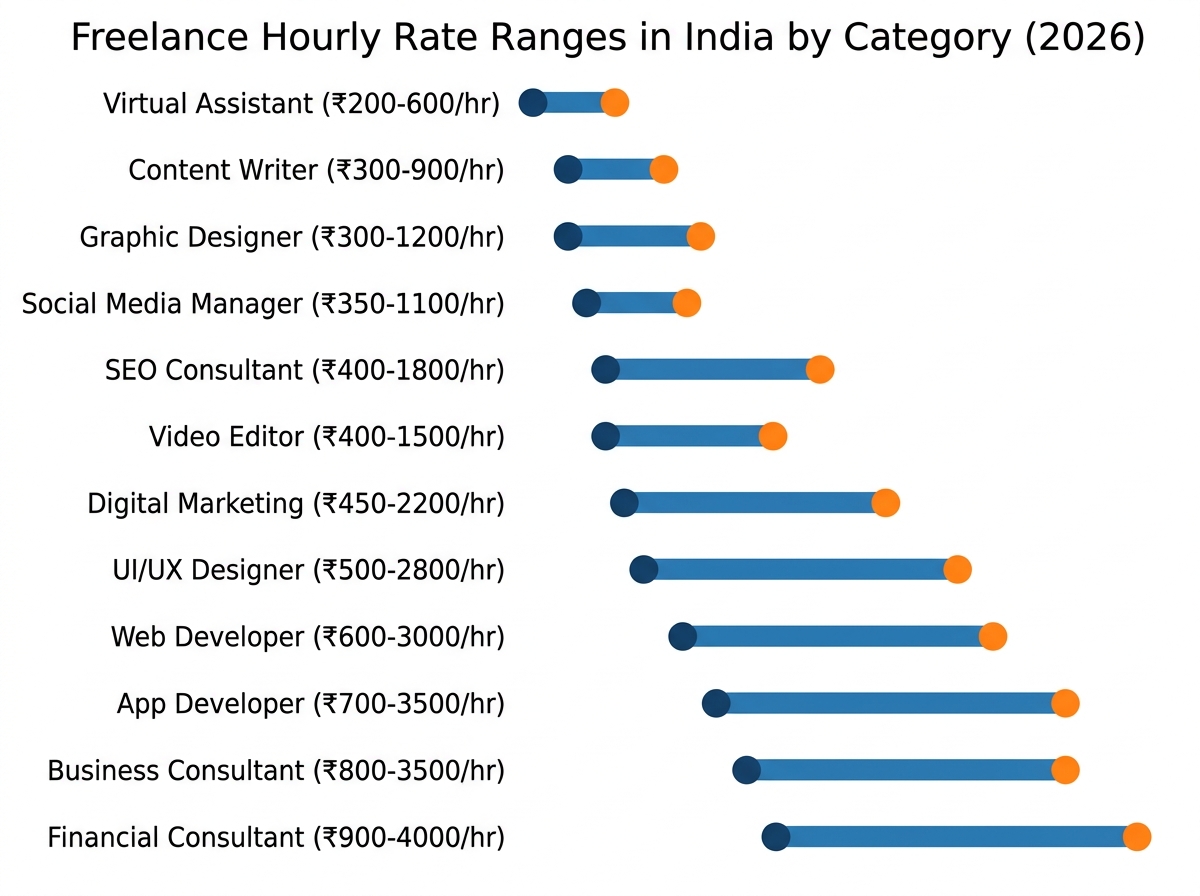
"What should I charge?" doesn't have one answer — it depends entirely on what you do. A virtual assistant and a financial consultant are both "freelancers," but their rate ranges don't overlap at all. This chart puts real ranges for 12 common freelance categories in India side by side, so you can see where your work actually sits before you quote a client.
The full rate chart
These ranges reflect typical hourly billing rates for Indian freelancers working with domestic and international clients in 2026:
| Category | Entry-level | Experienced | Typical driver of the spread |
|---|---|---|---|
| Virtual Assistant | ₹200/hr | ₹600/hr | Scope of responsibility, tools/software expertise |
| Content Writer | ₹300/hr | ₹900/hr | Niche specialization (technical, finance, SEO writing) |
| Graphic Designer | ₹300/hr | ₹1,200/hr | Portfolio strength, brand vs. general design work |
| Social Media Manager | ₹350/hr | ₹1,100/hr | Number of platforms, strategy vs. execution-only |
| SEO Consultant | ₹400/hr | ₹1,800/hr | Proven results/case studies, technical vs. content SEO |
| Video Editor | ₹400/hr | ₹1,500/hr | Complexity (basic cuts vs. motion graphics/VFX) |
| Digital Marketing | ₹450/hr | ₹2,200/hr | Paid ads management scale, measurable ROI track record |
| UI/UX Designer | ₹500/hr | ₹2,800/hr | Product design vs. general UI, SaaS/startup experience |
| Web Developer | ₹600/hr | ₹3,000/hr | Stack complexity, full-stack vs. front-end only |
| App Developer | ₹700/hr | ₹3,500/hr | Native vs. cross-platform, published app portfolio |
| Business Consultant | ₹800/hr | ₹3,500/hr | Industry specialization, strategic vs. operational work |
| Financial Consultant | ₹900/hr | ₹4,000/hr | Certifications (CA/CFA), scope (advisory vs. compliance) |
Three things that explain the wide range within every category
The gap between the entry-level number and the experienced number in almost every category is 3x to 5x. That spread usually comes down to three specific factors:
- Specialization beats generalism. A "content writer" charging ₹300/hr writing generic blog posts and a "content writer" charging ₹900/hr writing technical documentation for SaaS companies are doing genuinely different work, even though the job title is the same. The highest earners in every category on this list have picked a specific, valuable niche rather than staying generalist.
- Client type changes everything. A startup with a tight budget and an enterprise client with a compliance requirement will pay wildly different amounts for the same deliverable. This is less about your skill and more about who you're selling to — worth factoring into who you target, not just what you charge.
- Proof of results moves you up the range fast. This is most visible in SEO, digital marketing, and financial consulting — categories where the top of the range is 4-5x the bottom. A freelancer who can point to "I grew this client's organic traffic 3x" charges dramatically more than one who can only describe their process, even with similar raw skill.
How to use this chart for your own pricing
Don't just pick a number from your category and quote it. Use this chart as a reference point, then calculate your actual floor using your real costs — the same formula from our hourly rate guide: your take-home target, plus business expenses, plus a tax buffer, divided by realistic billable hours (not total working hours).
If your calculated floor lands below your category's range here, that's often a sign you're either underestimating your expenses/tax, or overestimating your billable hours — worth double-checking the math before you underprice yourself.
→ Calculate your exact hourly rate
A note on international clients
Every range above reflects the domestic Indian market. If you work with US, UK, or EU clients, rates commonly run 2-4x higher for the same category and skill level — but that comes with its own tax and GST considerations for export-of-services income, which is a separate topic from straightforward domestic pricing.
Frequently Asked Questions
Q: Why do rates vary so much even for the same job title?
Specialization, client type, and proven results explain most of the spread — see the three factors above. Two people with the same job title can reasonably charge very different rates if one has a sharper niche or stronger track record.
Q: Should I always aim for the top of my category's range?
Not necessarily — the top of the range usually reflects specialization and proven results that take time to build. Price honestly for where you currently are, and treat the top of the range as a target to grow into, not a starting point.
Q: Are these rates for hourly billing, or does it apply to project-based pricing too?
These are hourly reference points. Many experienced freelancers in the higher ranges (UI/UX, web/app development, consulting) move to project or retainer pricing once they have a repeatable process — use your hourly rate as the internal number you price projects against, not necessarily what you quote clients directly.